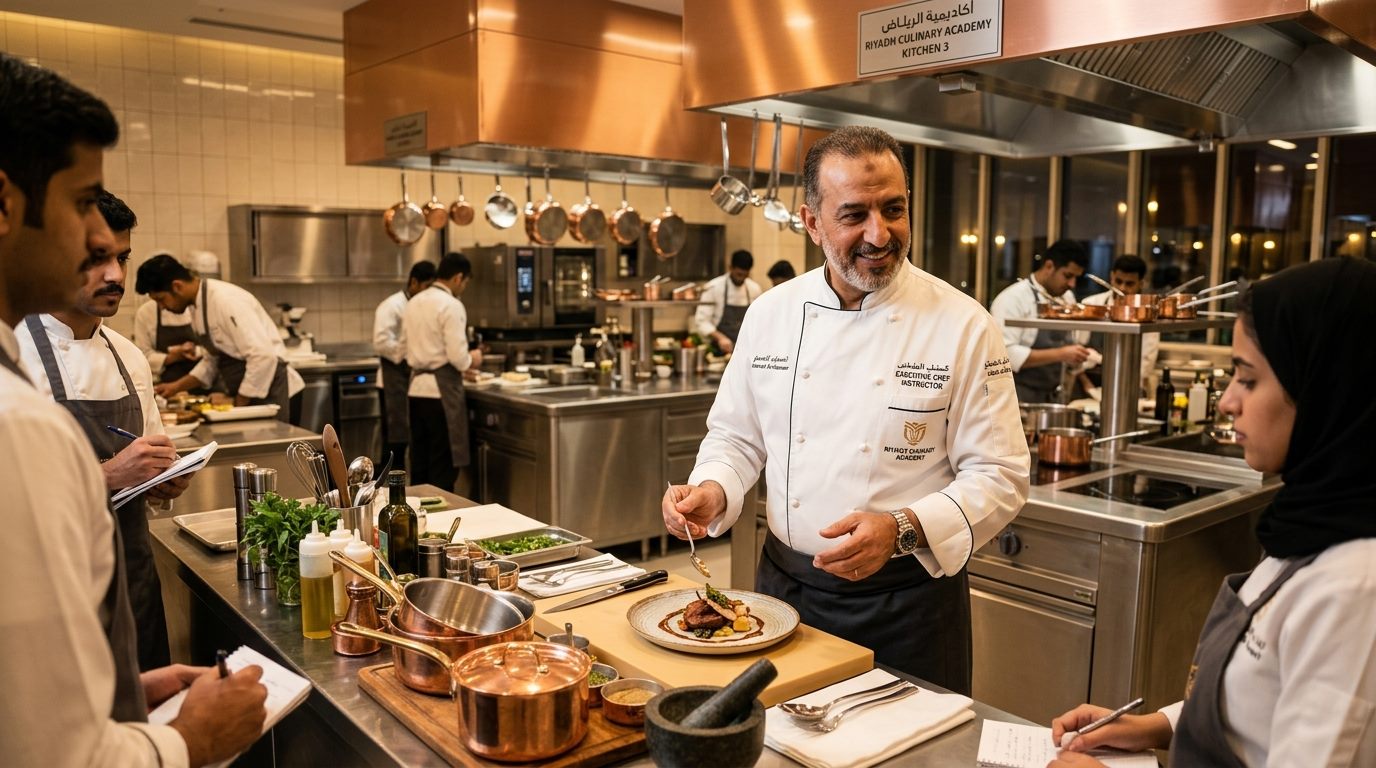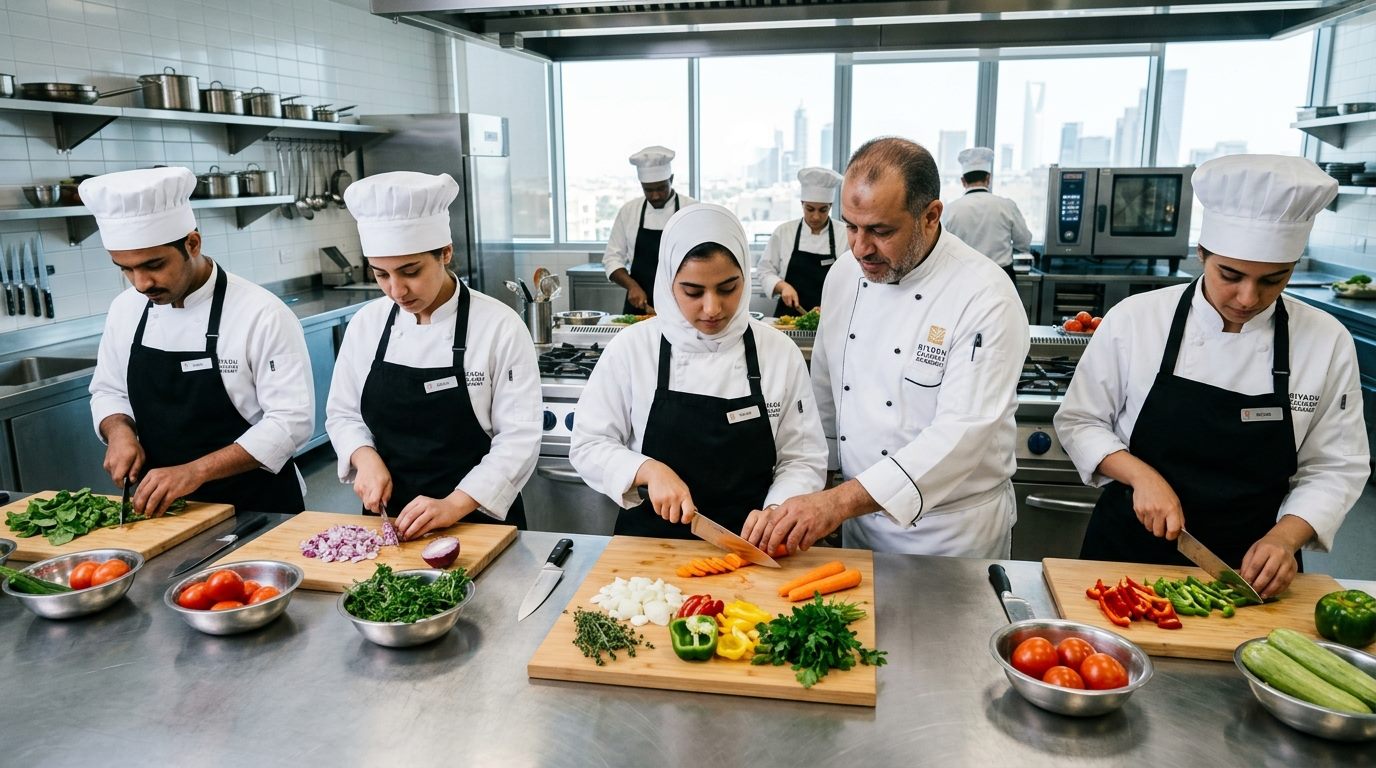
When aspiring chefs step into a high-tempo commercial kitchen in Riyadh, Jeddah, or Khobar, they quickly realize that real restaurant service is vastly different from home cooking. Speed, precision, and strict adherence to culinary discipline define who thrives on the line.
In the rapidly accelerating hospitality market of Saudi Arabia—fueled by premier hotel openings, tourism growth, and international restaurant concepts—executive chefs value candidates who possess rock-solid fundamental habits. You don’t need to know five hundred complex dishes on day one; you need to execute the core mechanics flawlessly under pressure.
1. Ergonomics & The Pinch Grip (Knife Skills That Protect & Accelerate)
Your chef’s knife (or French knife) is an extension of your forearm. Holding a knife with your index finger extended along the spine may feel intuitive to an amateur, but it creates unstable leverage, slows cutting speed, and causes severe wrist fatigue within an hour.
The Professional Pinch Grip: Grip the blade itself between your thumb and curved index finger right at the bolster, wrapping your remaining fingers comfortably around the handle. This shifts your center of gravity directly over the cutting edge, offering absolute stability and effortless chopping cadence.
- The Claw Technique: Keep the fingertips of your non-knife guide hand curled inwards like a bear claw, with knuckles resting flat against the flat of the knife blade. This guarantees you never cut your fingertips.
- Standard Cuts Mastered in Professional Kitchens:
- Julienne: Matchstick cuts measuring precisely 1/8 inch × 1/8 inch × 2 inches.
- Brunoise: Fine cubes derived from julienned vegetables, measuring 1/8 inch on all sides.
- Batonnet: 1/4 inch × 1/4 inch × 2 inches sticks, the foundation for standard dice.
- Chiffonade: Fine ribbon cuts applied to leafy herbs such as basil and mint.
- Honing Before Every Shift: A dull knife is dangerous because it requires force, causing slips. Regular honing steel alignment preserves the razor-sharp edge without shaving away metal.
2. The Sacred Discipline of Mise en Place
Mise en place is a French culinary philosophy translating to "everything in its place." In a commercial service where fifty tickets print simultaneously, you do not have time to peel a shallot, search for black pepper, or retrieve clean tasting spoons.
Before firing a single burner, a disciplined culinary professional organizes their station into distinct functional zones:
- Cutting Board Stability: Always position a damp kitchen cloth or rubber grip mat directly under your cutting board to prevent any movement while working.
- Tasting & Sanitation: Keep a sanitary container with fresh tasting spoons (never double-dip) and designated color-coded wiping cloths submerged in approved sanitizer solution.
- Portioning & Prep Trays: Measure, chop, and arrange all ingredients into standardized stainless steel insert pans ordered by the sequence of cooking.
- Clean as You Go: Wipe surfaces continuously between prep tasks. A clean workstation represents a calm, focused mind capable of handling high-volume dinner rushes.
"Technique can be learned in weeks. Discipline, station cleanliness, and clear communication are the true indicators of a candidate ready for Saudi Arabia's finest hospitality kitchens." — Chef Ahmed Al-Ghamdi, Head of Culinary Training
3. Heat Control & Pan Dynamics
Beginner cooks frequently treat burners as binary switches—either entirely off or full blast. Mastering heat requires understanding how different metals react and how food behaves upon contact with oil and surface tension.
When searing meats or sautéing vegetables:
- Preheat the pan first: Add oil to a hot pan, not a cold one. Look for the faint shimmer of oil or light vapor before introducing protein.
- Do not overcrowd the pan: Overcrowding causes food to release moisture faster than it evaporates, causing proteins to boil in their own juices rather than caramelize via the Maillard reaction.
- Listen to the sizzle: The sound of your pan communicates doneness. A vigorous, rhythmic sizzle indicates active moisture evaporation and crust formation. A sputtering silence warns that your heat is insufficient.
4. Food Hygiene, HACCP & Cross-Contamination Prevention
In Saudi Arabia’s professional culinary sector, health authorities and international hotel chains enforce stringent food hygiene protocols. Understanding Hazard Analysis Critical Control Points (HACCP) is mandatory for every kitchen team member.
- Temperature Danger Zone: Bacteria multiply rapidly between 4°C and 60°C (40°F to 140°F). Hot food must be held above 60°C; cold food must be stored below 4°C.
- Color-Coded Cutting Boards: Red for raw meat, blue for raw seafood, yellow for cooked meats, green for vegetables, and white for dairy/bakery.
- Handwashing Protocol: Wash hands thoroughly with warm water and antibacterial soap for a minimum of 20 seconds before touching food, after handling raw proteins, and after station changes.
5. Brigade Communication & Workplace English
Commercial kitchens in the GCC are multilingual environments staffed by chefs, prep cooks, and stewards from across the globe. Smooth communication prevents severe burns, collisions, and ruined orders.
- "Behind!" — Spoken firmly when walking behind another chef who may turn suddenly with a knife or hot pan.
- "Corner!" — Called out when rounding a blind hallway or kitchen corner.
- "Hot pan!" / "Sharp behind!" — Alerts everyone in the path of immediate physical danger.
- "Heard!" or "Yes Chef!" — Confirms that an instruction or timing call has been received and understood. Never stay silent on the line.